Most of us have memories scattered everywhere: photos buried in a camera roll, notes in random apps, messages exchanged years ago. The problem is rarely a lack of memories — it's that they're never connected. A personal life timeline fixes exactly that: it turns a pile of fragments into a story you can actually revisit, understand, and keep growing.
What is a life timeline, exactly?
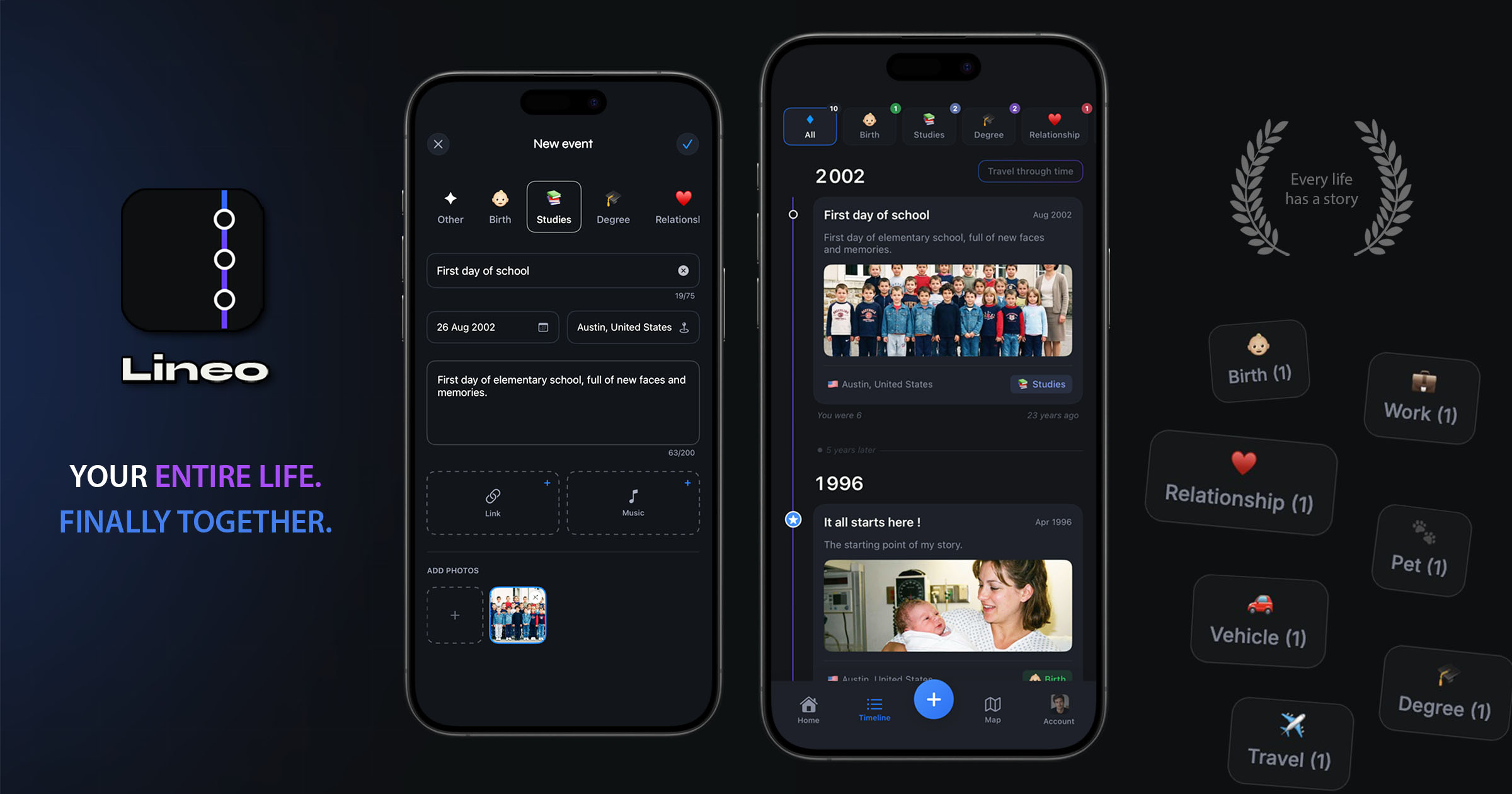
It's a chronological line that gathers the moments that matter: your birth, the places you've lived, graduations, trips, relationships, first times. Unlike a regular photo album, a timeline emphasizes time itself: how old you were when something happened, how many years have passed since, where it sits in the bigger picture of your life.
That time dimension changes everything. Realizing you were 22 during a particular trip, or that a move you barely think about happened eight years ago, creates a kind of perspective no single photo can give you.
Step 1 — Collect your raw memories
Before structuring anything, start by listing whatever comes to mind. You don't need to be exhaustive or chronological yet — just note the events that shaped you. Birth, school, your first apartment, your first job, meaningful relationships, trips, hard times you got through. The photos and messages already sitting on your phone are a great way to jog these memories loose.
Step 2 — Date each moment, even roughly
A timeline without dates isn't really a timeline. For each memory, attach at least a month and a year. If you don't remember the exact date, a rough estimate is more than enough — the goal is to recover the order and spacing of events, not day-level precision.
Step 3 — Give each event a category
Sorting memories into categories (housing, work, travel, relationships, milestones...) reveals patterns you'd never notice otherwise: how often you've moved, how many trips you've taken, how your career has actually evolved over time. This small step of categorizing is what turns a flat list into a real personal dataset.
Step 4 — Add context: place, photo, feeling
A date and a title are enough to rebuild a chronology, but it's the details that make a timeline feel alive: where you were, who you were with, a photo, a song that takes you right back. Years later, these small details are what actually bring the memory back.
Step 5 — Pick a format built to last
A spreadsheet, a notebook, a plain document can work to get started. But a life timeline is a project that grows with you over decades — it's worth using a tool designed for exactly that from day one: something that automatically shows your age at each event, organizes your memories on a map, and lets you add a new moment in seconds instead of reopening a messy file.
That's the whole idea behind Lineo: an app built for exactly this, displaying your life as a timeline, showing your age at every event, mapping every place you've lived or visited, and surfacing stats about the categories of memories you've collected.
Step 6 — Come back to it regularly
A life timeline is never really finished. The point isn't to fill it in once and forget about it — it's to add an event now and then, revisit it whenever you need perspective, and rediscover it in ten or twenty years to remember exactly who you were at a given moment.
In short
- Write down your memories without aiming for perfection right away.
- Date every event, even roughly.
- Categorize to surface real patterns.
- Add context: place, photo, feeling.
- Choose a tool built to last, not just a file.
A well-built life timeline becomes, over the years, one of the most valuable things you can own: an honest summary of everything you've lived through.
