Writing your personal biography means telling the events, encounters, choices, and periods that have shaped your life. Contrary to what you might sometimes think, you do not need to have lived an extraordinary life or write a book hundreds of pages long to get started.
A biography can take many different forms. It can be a long narrative, a collection of memories, a life journal, or simply a series of important events placed in chronological order.
The important thing is not to tell everything. Instead, it is about preserving what matters and giving structure to your personal story.
What Is a Personal Biography?
A biography is the story of a person's life. When it is written by the person themselves, it is more precisely called an autobiography.
In practice, these two terms are often used to describe the same goal: telling the story of your journey, experiences, and the events that have shaped your life.
A personal biography can describe the major stages of a life, but also the details that help us understand a particular period or personality: the places where you have lived, the people you have met, the jobs you have had, the trips you have taken, the passions you have discovered, or the decisions that changed the direction of your life.
Biography, Autobiography, or Memoir: What's the Difference?
These three terms are closely related, but they do not describe exactly the same approach.
Biography
A biography tells the story of a person's life. It can be written by someone else, based on interviews, documents, photographs, and research.
Autobiography
An autobiography is the story of your own life. You tell your own journey, memories, and the events that have shaped your story.
Memoir
Writing your memoirs focuses more on the events and experiences that you consider important in your life. Memoirs can therefore be more selective than a complete autobiography.
In every case, the goal remains similar: to leave a record of your personal story.
Why Write Your Personal Biography?
The first reason is often to pass something on to others.
Over the years, family memories can disappear. Some stories may only be known by one person. Places change, photographs lose their context, and details from a particular period can become difficult to remember.
Writing your biography allows you to preserve this information for yourself, but also for the people close to you.
It is also a way to step back and reflect on your own journey. By putting events in chronological order, you may sometimes discover connections between periods that seemed unrelated while you were actually living through them.
A personal biography can therefore become both a life story, a personal record, and a legacy for future generations.
Where Should You Start When Writing Your Biography?
The hardest part is often writing the first sentence.
When faced with an entire lifetime, it is easy to feel that you need to tell everything in order, from birth to the present day. This approach can make the project particularly difficult.
A simpler method is to start with the major stages of your life.
- Your birth and childhood.
- The places where you have lived.
- Your schooling and education.
- Your first professional experiences.
- Important people you have met.
- Your relationships and family.
- Trips that have stayed with you.
- Major changes in your life.
- Achievements and projects you are proud of.
- Difficult periods and what they taught you.
This first list already gives you a kind of skeleton for your biography.
Create a Timeline Before You Start Writing
Before writing long paragraphs, it can be much easier to reconstruct the timeline of your life.
Write down the events you remember, even if some dates are approximate. You can then gradually complete them using your photos, personal documents, or memories shared by your family.
For example:
- 1990 — Birth.
- 1996 — First day of school.
- 2008 — Started higher education.
- 2012 — First job.
- 2015 — Moved to a new city.
- 2018 — Important trip.
- 2021 — Major career change.
This method makes it immediately easier to see the different periods of your life.
It is closely related to the idea of a life timeline: before even writing the story, you can reconstruct the thread of events that make up your personal history.
Which Memories Should You Include?
There is no universal list of memories that should be included in a biography.
An event may seem insignificant to one person and extremely important to another.
However, it can be helpful to look for certain types of memories:
- first experiences;
- encounters that changed something in your life;
- moves and changes of where you lived;
- trips and travels;
- career milestones;
- important relationships;
- passions discovered over the years;
- decisions that changed the direction of your life;
- happy moments;
- difficult periods;
- ordinary events that you are particularly attached to.
Small events should not be overlooked. An evening with friends, your first car, an apartment where you lived for a few months, or a particular conversation can sometimes have more value in a biography than an event that is officially considered important.
Photos Can Help You Rediscover Your Story
When trying to write your personal biography, photographs are excellent memory triggers.
An old photo can bring back a place, a person, or a period that you had almost forgotten.
By going through your old photos, you may rediscover:
- the places where you lived;
- the people who were around during a particular period;
- the trips you took;
- different cars or homes you had;
- family events;
- professional or school periods.
It can therefore be useful to connect photos, dates, and events rather than keeping each element separately.
Do You Have to Write Your Whole Life in Chronological Order?
Not necessarily.
A personal biography can be organized chronologically, but it is not a requirement.
Some people prefer to tell the story of their childhood first, followed by their education and professional life. Others prefer to begin with a particularly important event and then go back to the periods that came before it.
If your main goal is to preserve your story, however, a chronological approach remains a particularly simple method. It allows you to quickly find the different periods of your life and understand how events followed one another.
How Do You Write Your Biography If You Don't Like Writing?
This is an important difficulty: some people have countless memories but simply do not enjoy writing.
In that case, there is no need to start with several pages of text.
You can begin with a few lines:
- what happened;
- where it happened;
- how old you were;
- who you were with;
- why this memory is important.
A few sentences may already be enough to preserve an event.
Later, when you feel like coming back to it, these few lines can be expanded and turned into a more detailed story.
Your Biography Doesn't Have to Be a Book
When people talk about a personal biography, they often imagine a printed book with hundreds of pages and a carefully developed structure.
That is one possibility, but it is not the only one.
Not everyone wants to spend several months writing an autobiographical book. And above all, not everyone needs to tell every detail of their life.
A personal story can also be built event by event, year by year.
A move today. A trip a few weeks later. An important encounter. A professional achievement. A photograph rediscovered in an old gallery.
Little by little, these fragments form a much more complete picture of your journey.
Build Your Biography as a Life Timeline
There is another way to tell your story: instead of starting by writing an entire book, you can begin by preserving the events that mattered.
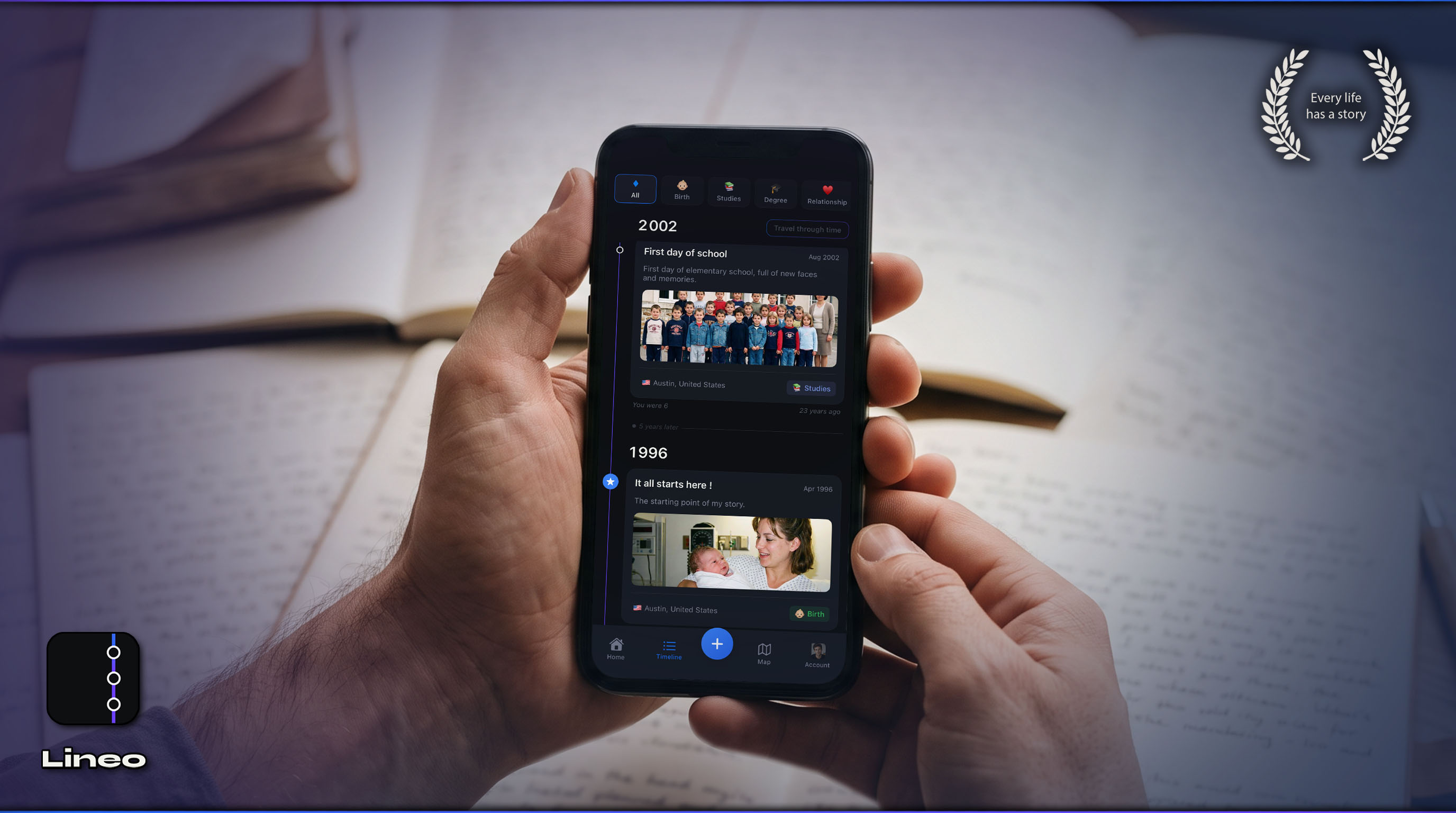
Each event can include a date, an age, a place, a photo, and a few lines of context.
At first, the timeline may seem very simple. Then it gradually becomes richer.
After a few months or years, it becomes a real representation of your journey: the places where you have lived, the people you have met, the trips you have taken, the different stages of your professional life, and the memories you want to preserve.
This is precisely the approach offered by Lineo.
Rather than asking you to write your entire life story immediately, Lineo allows you to gradually build your personal story by adding your events over time.
Write Your Biography Today So You Don't Forget Tomorrow
The best time to write down a memory is often while it is still recent enough for its details to be accessible.
In ten or twenty years, you will probably still remember the major stages of your life. But some details may have disappeared: the name of a restaurant, the address of an apartment, the people who were in a particular photo, the age you were, or simply how you felt during that period.
Preserving this information gradually means you will not have to reconstruct your entire story from memory several decades later.
A Story That Can Keep Being Written
A personal biography does not necessarily have to be a project that you finish one day.
Your story continues.
A new job, a trip, a new relationship, a move, a completed project, or simply a moment you want to remember can become a new event.
That is why a personal story can be built gradually, at the same pace as life itself.
In Summary
- A personal biography tells the events that have shaped your journey.
- When you tell your own life story, it is generally called an autobiography.
- You do not need to write a book to preserve your story.
- A timeline makes it easy to structure the different periods of your life.
- Photos and small events are valuable memory triggers.
- A few lines can be enough to start telling a memory.
- A timeline allows you to gradually build a personal biography, one event at a time.
Start Telling Your Story
You do not need to wait until you have time to write an entire book.
Simply start with an event you remember today.
Add a date, a place, a photo, and a few words. Then come back later to continue building your story.
With Lineo, your personal biography can be built gradually, one memory at a time.
