We all know the major milestones of our lives. Our birth, childhood, education, first jobs, important relationships, travels, moves, achievements and sometimes difficult periods.
But when we try to tell our life story in chronological order, something surprising happens: between the major events, there are dozens of small moments we had completely forgotten.
Creating a life timeline is therefore not simply about making a list of dates. It is a way to step back and look at your journey, understanding how all these moments gradually connected to form your personal story.
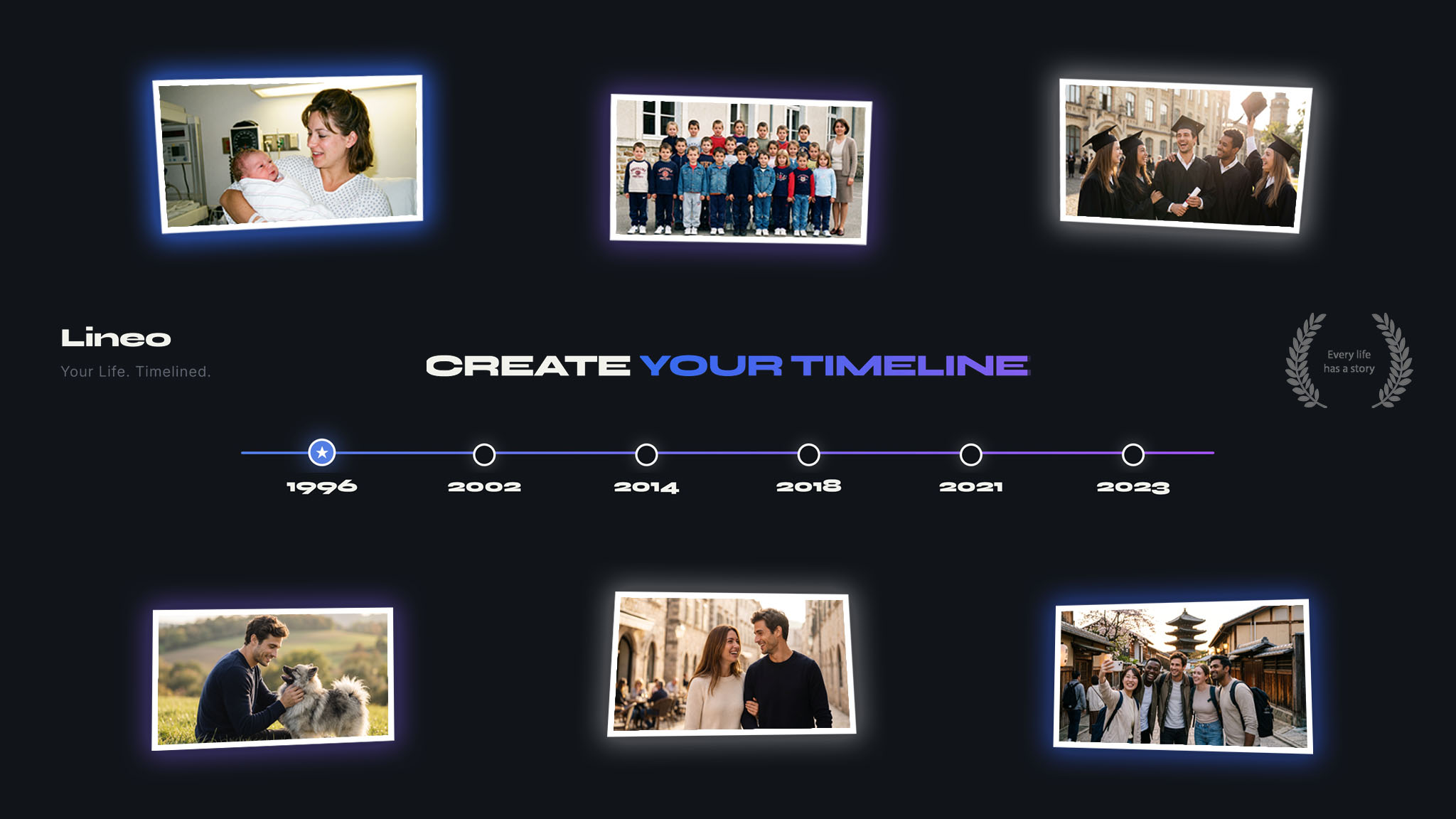
A life is a story before it is a list of dates
Imagine a horizontal line.
On the left, your birth. Then school, a first relationship, a move, a degree, a first job, a trip, a new relationship, a major change in your life...
Each point represents an event.
Individually, these events may seem ordinary. But when they are placed on the same timeline, something appears: a story.
That is the difference between remembering a few moments and actually being able to see your journey.
A timeline allows you to see the different periods of your life as if they were chapters in a book.
Why create a timeline of your life?
The most obvious reason is to preserve your memories. But a personal timeline can serve another purpose: it allows you to step back and look at your own journey from a different perspective.
We never experience our lives with a complete overview.
At 20, you do not yet know what the next decade will bring. At 30, parts of your teenage years may already feel very distant. At 40 or 50, entire periods of your life can begin to blend together.
Placing events on a timeline helps restore that perspective.
You can see:
- the different cities and places where you have lived;
- important periods in your education;
- how your professional life has evolved;
- the people you have met along the way;
- the trips and countries you have discovered;
- the major changes in your life;
- the passions you discovered and later left behind;
- the happy or difficult periods you went through;
- the people who were part of different chapters of your journey.
Your timeline becomes a kind of map of your own life.
The major milestones tell a story
To start creating a life timeline, you do not need to immediately remember every single date.
Start with the major milestones.
Childhood
Your birth, the first home you remember, school, your first friends, activities you enjoyed as a child...
Some of these memories will be very precise. Others may only come back as fragments.
That is perfectly fine.
An old photograph, a former home or the name of a childhood friend can sometimes be enough to bring an entire period back to memory.
Education
Primary school, high school, university, a degree, a change of direction or a particularly memorable year can all become important milestones.
Education often provides a natural structure for a period of your life.
Your first professional experiences
Your first summer job, first contract, a promotion, a career change or starting your own business can all become important milestones.
With hindsight, you may realize that certain professional decisions completely changed the direction of your life.
Relationships and encounters
A personal timeline should not only contain degrees and moves.
Some people have a much greater importance in our stories.
Meeting a partner, a friendship that lasts for decades, the birth of a child or someone you met almost by chance can become one of the most important points on your timeline.
Travel and places
A trip may last only a week and yet remain associated with an entire period of your life.
A country you discovered for the first time, a city where you lived, a trip with friends or a move abroad can all become landmarks that bring back the atmosphere of a particular time in your life.
The smallest events can sometimes be the most valuable
It would be easy to build a timeline using only official milestones: birth, graduation, marriage, employment, retirement.
But a life is not limited to those things.
Some memories that seem insignificant today become especially precious over time.
A night out with friends. Your first car. An apartment where you lived for a few months. A pet joining your family. A song associated with a particular period. A memorable summer. A conversation you still remember years later. A day when you made an important decision without realizing how much it would change what came next.
These events do not appear in any official record. Yet they are part of your story.
Often, what truly makes up our lives is found between the major dates.
Photos can help rebuild a forgotten timeline
Photographs are particularly useful when trying to reconstruct your past.
Looking through an old photo library can bring back places, faces, trips or events whose dates you had completely forgotten.
A photograph can become the starting point for an entire memory.
You recognize a street. Then an apartment. Then the people who were there. And suddenly, an entire period comes back.
That is why a personal timeline works particularly well when it combines dates, events and photographs.
A photo preserves the moment. A timeline gives that moment its place in your story.
What if you could see your entire life on one line?
It is perhaps one of the simplest ways to represent our existence: a timeline, a few dates and events gradually appearing along the years.
On the left, the early years. In the middle, the different stages of adulthood. Further along, projects, travels, relationships and new chapters.
The story becomes almost visual.
You can immediately see that an event happened when you were 18, that another took place ten years later, or that a particular career period occupied a large part of your journey.
This perspective is very different from a traditional photo album.
A photo album shows images. A timeline shows how those images fit into the passage of time.
A timeline that grows throughout your life
You do not need to wait until you are 60 or 70 to start documenting your story.
In fact, starting early allows you to preserve details that may gradually disappear from memory.
Your timeline does not need to be finished either.
It can evolve throughout your entire life.
Today, you might add your first job. A few years from now, a new trip. Later, a relationship, a move, a project you completed or simply a moment you want to remember.
Your timeline becomes a living document that grows with the person who created it.
Trace your life for yourself… and for those who come after you
There is another reason to create a personal timeline: passing your story on to future generations.
We usually know a few major milestones from our parents' or grandparents' lives.
But do we really know what their everyday lives were like?
How old were they when they left their hometown? When did they meet their partner? What was their first job? Where did they live at 25? Which countries did they visit? What dreams did they have when they were young?
A timeline allows this information to be preserved in a much more concrete way than a story simply passed down from memory.
It can become a genuine family record, allowing future generations to discover not only what happened, but how the different chapters of a life unfolded.
How to create your personal timeline
There is no single right way to do it.
You can start on paper, in a notebook, in a document or with an app.
The important thing is to begin with the milestones you remember most clearly.
A simple method is to:
- write down the major milestones of your life;
- gradually add the dates;
- add the important places and people;
- find the photographs associated with those moments;
- add the smaller events that come back to you;
- return regularly to fill in the gaps.
There is no need to try to reconstruct your entire life in one sitting.
A timeline becomes valuable precisely because it can be gradually enriched over time.
A personal story that grows with time
This is the idea behind Lineo.
Instead of keeping your memories scattered across photo albums, notes and different apps, Lineo lets you bring them together into one personal story.
Each event takes its place on a timeline, with its date, your age, its location, photos and the details you want to preserve.
Little by little, a few events become a timeline.
Then the timeline becomes a story.
And that story becomes a unique representation of your journey.
Your life may deserve to be seen differently
We spend a lot of time preparing for the future and living in the present.
We spend much less time looking back at the path we have already travelled.
Yet when we bring together the events that shaped our lives, we sometimes discover a different story from the one we had in mind.
Forgotten periods reappear. Certain encounters take on a new importance. Old decisions help explain choices we make today. And moments we once considered ordinary may become the ones we most want to preserve.
Creating a timeline of your life is ultimately about taking a moment to look back at the road you have travelled.
And perhaps realizing that this story deserves to be preserved.
Start your timeline today
You do not need to remember your entire life to begin.
Simply add your first event. Then a second. Then a third.
Over time, the points will appear along the line and your story will begin to take shape.
With Lineo, your life becomes a story you can see, complete and preserve over the years.
In summary
- A life timeline allows you to step back and see your personal journey.
- Major milestones such as childhood, education, work, relationships and travel naturally structure a life.
- The small everyday moments are often the memories we value most.
- Photos can help reconstruct forgotten periods of your life.
- A personal timeline can also become a way to preserve your family history.
- With Lineo, your story grows gradually, one event at a time.
